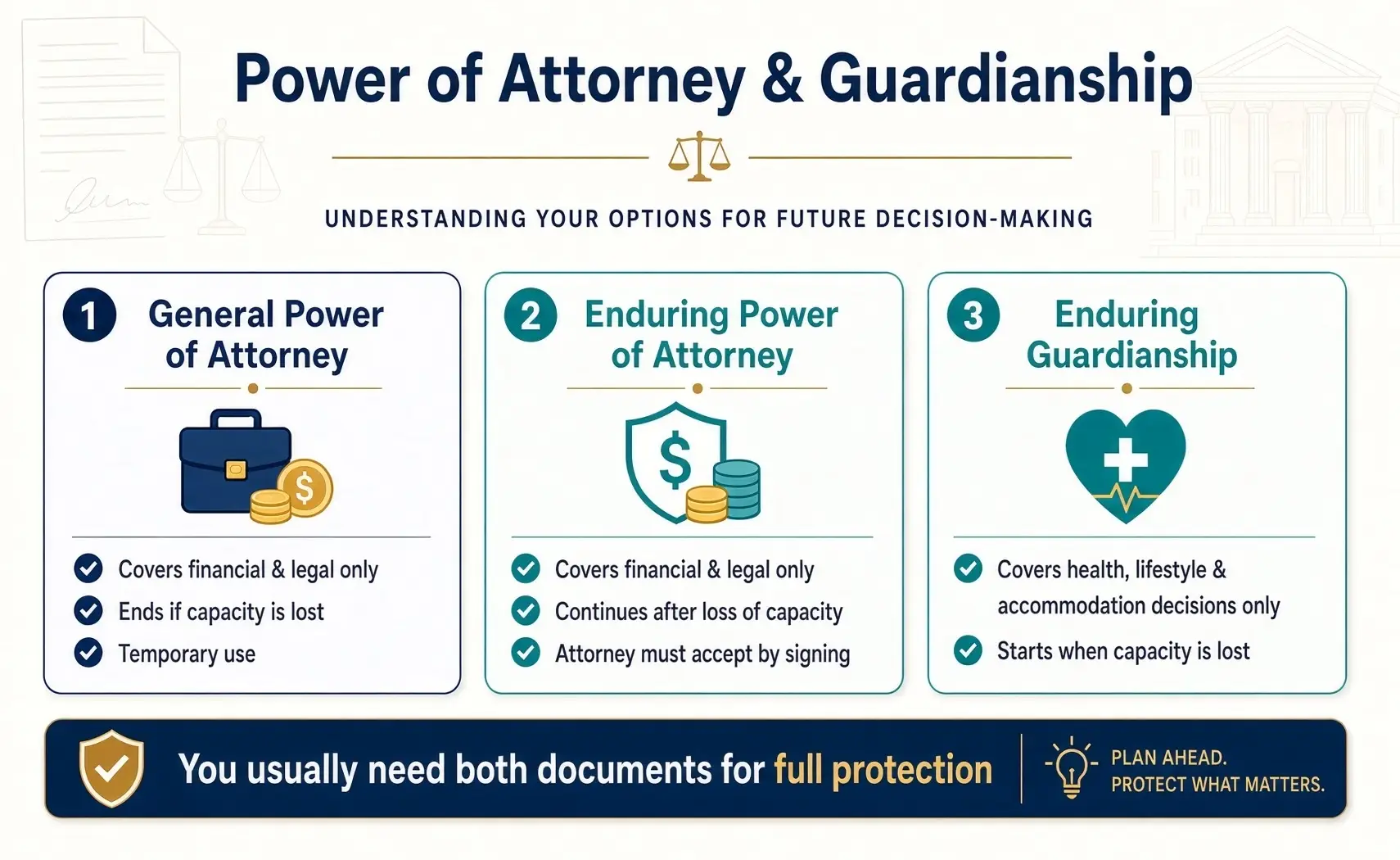
Life rarely follows a neat plan. A sudden illness, accident, or gradual decline in capacity can leave families scrambling for answers about who can pay the bills, manage the house, consent to medical treatment, or decide where someone lives. In New South Wales, two complementary documents—Power of Attorney (for finances and legal matters) and Enduring Guardianship (for personal, health, and lifestyle decisions)—give you the chance to choose trusted people in advance rather than leaving those choices to a tribunal or the courts.
Getting them right while you still have capacity is one of the most effective ways to reduce stress for the people you love and keep control over your own future.
Power of Attorney in NSW: General vs Enduring
A Power of Attorney lets you appoint one or more people (called attorneys) to handle financial and legal decisions on your behalf. In NSW, governed by the Powers of Attorney Act, there are two main versions.
General Power of Attorney
This is useful for temporary situations while you still have capacity—such as an extended overseas trip, a hospital stay, or simply needing help managing day-to-day affairs. Your attorney can operate bank accounts, pay bills, manage investments, or deal with property, within any limits you set. Importantly, a general Power of Attorney becomes ineffective for decisions beyond your understanding once you lose capacity. It also ends if you die or revoke it.
Enduring Power of Attorney
This is the version most people need for long-term planning. It continues to operate even after you lose the ability to make decisions for yourself. You can choose whether it starts immediately or only when you lose capacity. Like the general version, it covers financial and legal matters only—banking, property, investments, contracts, and similar tasks. It ends on your death (your Will then takes over) or if properly revoked while you still have capacity.
Key practical differences include stricter witnessing rules for an Enduring Power of Attorney (it must be witnessed by a prescribed witness such as a solicitor, barrister, Local Court registrar, or certain other authorised people, who must also certify that they explained the document and that you appeared to understand it). Registration with NSW Land Registry Services is only required if the attorney needs to deal with NSW real estate.
Guardianship in NSW: Enduring Appointment vs Tribunal Orders
Guardianship focuses on personal, health, and lifestyle decisions rather than money.
Enduring Guardianship
While you still have capacity, you can appoint one or more Enduring Guardians under the Guardianship Act 1987. Their role typically begins only when you need a guardian (i.e., once capacity is lost). They can make decisions about where you live, what support services you receive, and consent to medical or dental treatment (within limits—they generally cannot override a clear objection you have previously expressed). The document must be in the approved form and properly witnessed, and the guardian must accept the appointment.
Tribunal-appointed Guardianship
If you lose capacity without having appointed an Enduring Guardian, anyone with a genuine concern can apply to the NSW Civil and Administrative Tribunal (NCAT) Guardianship Division. NCAT can appoint a private guardian (often a family member) or the NSW Public Guardian to make personal and health decisions. This process can be slower, more public, and less aligned with your specific preferences than an advance appointment you control yourself.
In short: Enduring Guardianship is the proactive “regular” planning tool; a NCAT guardianship order is the reactive fallback.
Most people are best served by having both an Enduring Power of Attorney *and* an Appointment of Enduring Guardian (often naming the same trusted person or people, or complementary ones). Together they cover the major decisions that arise when capacity is lost. An Advance Care Directive can further record your specific medical wishes.
Pro tip: An Enduring Power of Attorney does not give your attorney any authority until they formally accept the appointment by signing the document (section 20 of the Powers of Attorney Act 2003). Signing and witnessing the form yourself is not enough—the attorney’s acceptance is essential. The same principle applies to Enduring Guardians. Always confirm acceptance is completed and consider naming substitute attorneys or guardians in case your first choice cannot act.
Concerned family members or others with a genuine interest can apply to NCAT’s Guardianship Division to review an Enduring Power of Attorney or Enduring Guardianship appointment. NCAT can examine whether the person had capacity when they signed, whether there was undue influence, or whether the attorney/guardian is acting in the principal’s best interests. It can confirm, vary, suspend, or revoke the appointment and, if needed, appoint a financial manager or guardian. Applications to the Supreme Court are also possible but rarer and more expensive. Acting early with evidence (medical records, financial statements, etc.) is important.
For finances, family or friends may need to apply to NCAT for a financial management order (or the NSW Trustee and Guardian may be appointed). For personal and health decisions, NCAT can appoint a guardian, or the law’s “person responsible” hierarchy may apply for certain medical consent. These processes take time and remove your ability to choose who decides.
Yes, while you still have capacity. Use the proper form and notify the attorney/guardian (and register the revocation if the original was registered for land dealings). Once capacity is lost, revocation generally requires a tribunal or court process.
While standard forms are available, legal advice is strongly recommended. Prescribed witnesses for enduring documents must be satisfied you understand the effect, and poorly drafted limitations or missing substitutes frequently create problems later. A solicitor can also help tailor conditions (for example, requiring joint decisions for large transactions or limiting gifts).
Yes, and many people choose this for simplicity. You can also appoint different people or joint/several arrangements and name substitutes.
NSW generally recognises valid interstate enduring powers of attorney, but rules differ by state. Check carefully if you move or own property elsewhere.
A Power of Attorney (whether general or enduring) authorises the attorney to make financial and legal decisions only. Typical powers include operating bank accounts, paying bills, managing investments, collecting income, signing contracts, and buying or selling property (subject to any limits you include in the document). It does **not** cover medical treatment, where you live, or other personal or lifestyle decisions—those require a separate Appointment of Enduring Guardian.
Attorneys in NSW owe strict fiduciary duties to the principal. They must:
– Always act in the principal’s best interests
– Keep the principal’s money and property completely separate from their own
– Keep reasonable accounts and records of all transactions and decisions
– Not gain any personal benefit from the role unless the document expressly authorises it (for example, a limited gift or reimbursement clause)
– Act honestly in all matters concerning the principal’s legal and financial affairs
These obligations are reinforced in the standard acceptance wording an attorney must sign. Breaching them can expose the attorney to civil liability (including having to repay money or compensate the principal) and, in serious cases, criminal penalties. NCAT can also review the attorney’s conduct, order accounts, vary or revoke the appointment, and appoint a substitute financial manager if needed.
Because the powers are broad and the duties are strict, it is wise to choose someone trustworthy, consider clear instructions or limitations in the document, and obtain legal advice when preparing it.
These documents are straightforward when prepared properly and can spare your family significant stress, cost, and uncertainty. The best time to put them in place is while everyone is well and thinking clearly.
If you’d like tailored advice on your circumstances or help preparing these documents correctly, contact our team—we regularly assist clients across NSW with estate planning that actually works when it matters.