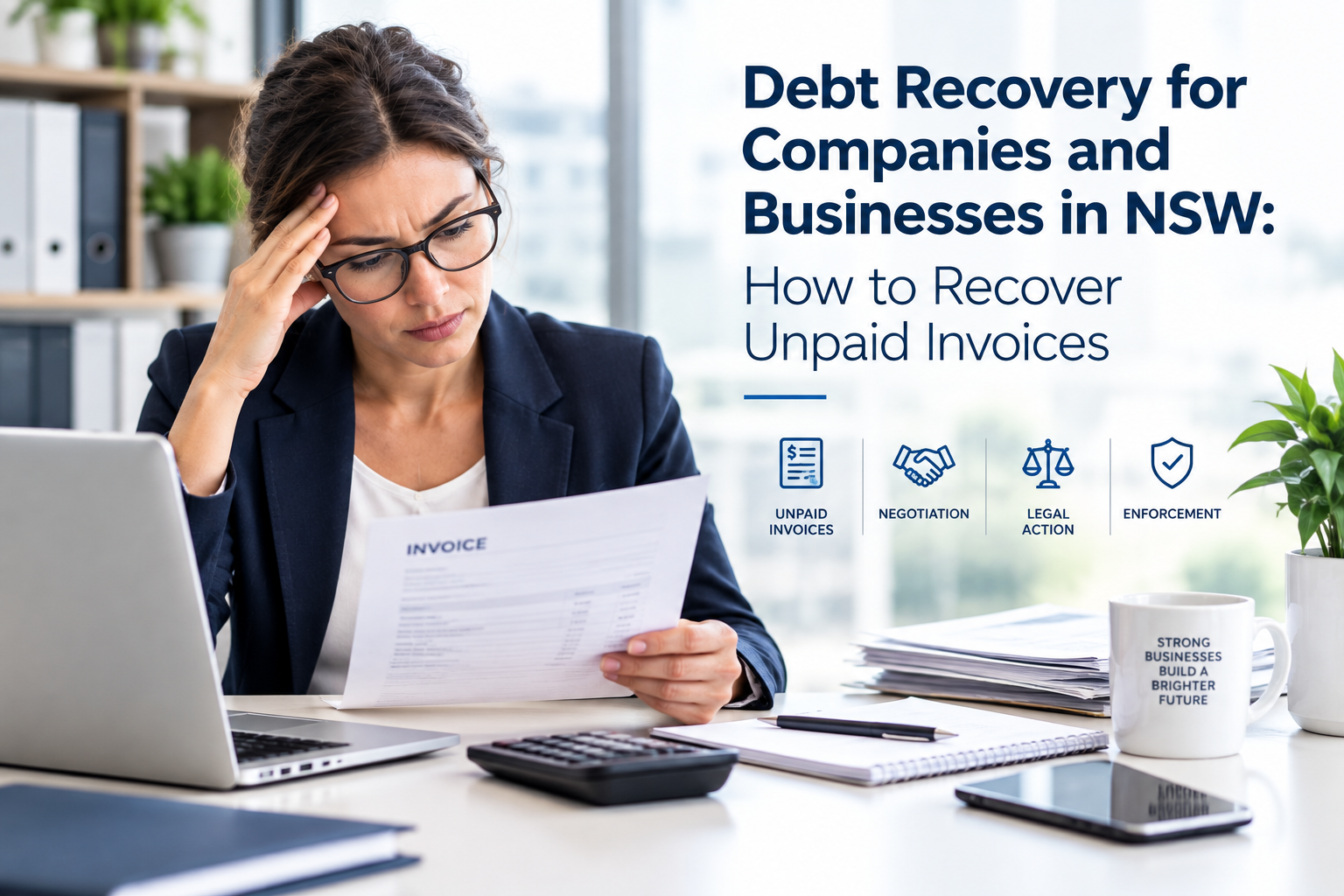
For many businesses, getting paid on time is essential to keeping the business running.
When a customer or another business fails to pay an invoice, the debt can quickly become frustrating and time-consuming. You may have sent reminders, made phone calls and followed up by email, but the money still has not been paid.
So, what can your business do?
There are several steps a company or business can take to recover an unpaid debt in NSW. In many cases, it is sensible to try to resolve the matter before commencing court proceedings.
What is debt recovery?
Debt recovery is the process of trying to recover money that is legally owed to your business.
For a business, this commonly involves:
- unpaid invoices;
- unpaid accounts;
- outstanding fees;
- loans or advances;
- unpaid goods or services;
- amounts owed under a contract; or
- other commercial debts.
The appropriate approach will depend on the circumstances of the debt and whether the customer or other business disputes that the money is actually owed.
Check your records
Before taking action, make sure your business has clear records supporting the debt.
This may include:
- contracts;
- invoices;
- purchase orders;
- quotes;
- delivery records;
- timesheets;
- receipts;
- emails;
- text messages;
- account statements;
- payment records; or
- correspondence with the customer.
You should also make sure your records clearly establish who owes the money.
This is particularly important when dealing with businesses.
For example, a business may trade under a particular business name but operate through a different legal entity. Before commencing legal proceedings, you should make sure the correct company, sole trader or other legal entity is identified.
Confirm exactly how much is owed
Make sure your accounts are up to date before demanding payment.
Check whether:
- any payments have been made;
- credits have been applied;
- invoices have been cancelled or adjusted;
- there are disputed amounts;
- interest is being claimed; or
- other amounts need to be deducted.
Your demand for payment should be based on an amount that you can properly support with your records.
Contact the customer
Before taking formal legal action, consider contacting the customer to find out why the account has not been paid.
There may be a simple explanation.
For example:
- the invoice may have gone to the wrong person;
- the customer may have a cash-flow problem;
- the customer may believe there is an error with the invoice;
- there may be a dispute about the goods or services; or
- the customer may simply have overlooked the payment.
Where appropriate, you may be able to resolve the matter by agreeing to a payment date or payment plan.
Resolving the matter commercially can save your business the time and expense associated with legal proceedings.
Send a Letter of Demand
If informal attempts to recover the debt have failed, your business may consider sending a Letter of Demand. A Letter of Demand is a formal request requiring the debtor to pay the amount you say is owing.
How LegalWise Solutions Can Help With Debt Recovery
Chasing unpaid debts can take valuable time away from running your business.
LegalWise Solutions can assist companies and businesses with debt recovery matters in NSW, from the initial Letter of Demand through to court proceedings and enforcement where appropriate.
Our approach is to help you understand your legal options and take a practical approach to recovering money owed to your business.
If your business is dealing with unpaid invoices or outstanding debts, contact LegalWise Solutions today to discuss your debt recovery options.
Frequently Asked Questions
A customer may claim that:
- the goods were defective;
- the services were not completed;
- the work was not performed properly;
- the price was different from what was agreed;
- the invoice contains errors;
- they have already paid;
- they were entitled to a discount or credit; or
- they never agreed to the work or purchase.
If the debt is genuinely disputed, it is important to understand the basis of the dispute before commencing proceedings.
Your business should review the contract and supporting evidence and consider whether the amount claimed is legally recoverable.
If the debt remains unpaid after your attempts to resolve the matter, your business may need to consider commencing court proceedings.
In NSW, the Local Court deals with civil claims up to $100,000.
Generally:
- claims up to $20,000 are dealt with in the Small Claims Division;
- claims over $20,000 and up to $100,000 are dealt with in the General Division; and
- larger claims may fall within the jurisdiction of the District Court or Supreme Court.
The appropriate court and procedure will depend on the circumstances of the claim.
Before commencing court proceedings, it is worthwhile seeking legal advice to ensure the next steps are tailored to your business and circumstances. Getting advice early may help your business understand its options before unnecessary costs are incurred.
Debt recovery can be more complicated when the debtor is another company.
Before spending significant money pursuing the debt, it may be useful to consider the company’s financial position.
For example:
- Is the company still trading?
- Does it appear to have assets?
- Does it have other creditors?
- Is it experiencing financial difficulties?
- Has it stopped trading?
- Is there a risk of insolvency?
These factors can affect the practical prospects of recovering the debt.
A judgment against a company that has no recoverable assets may not result in the payment your business is seeking.