If you are signing a commercial or retail lease in NSW, one of the most important clauses to understand is the rent review clause.
A rent review clause explains how and when the rent can increase during the lease term.
Many business owners focus heavily on the starting rent, but the review mechanism can have a major impact on the total amount paid over the life of the lease to the landlord.
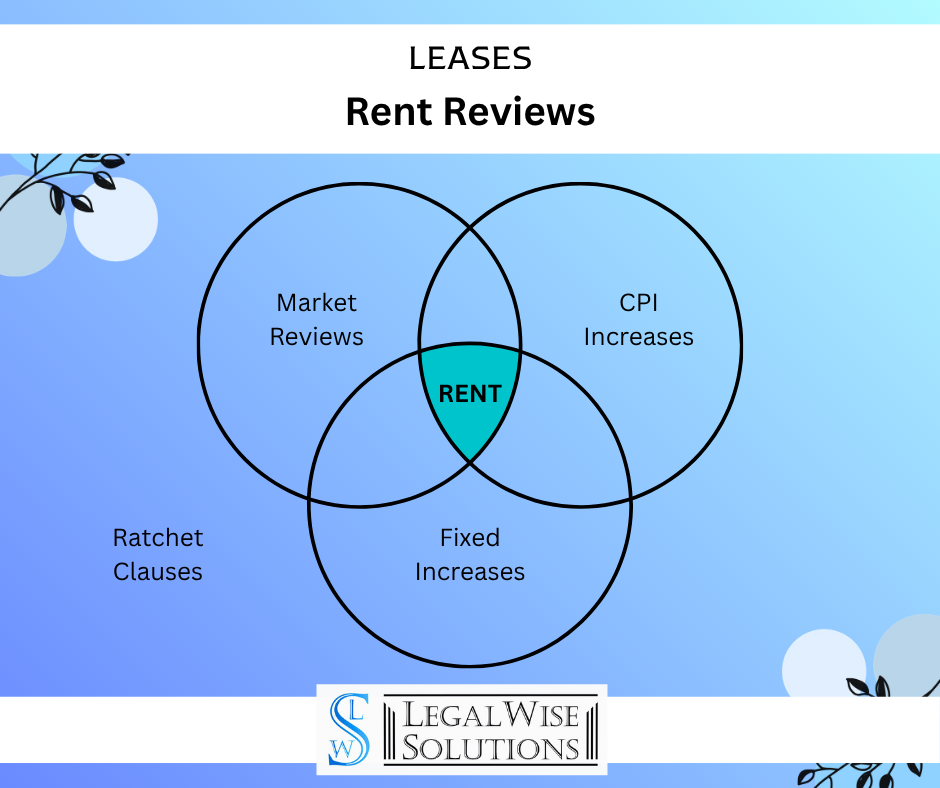
In NSW, commercial leases commonly use four types of rent review mechanisms:
- CPI increases;
- fixed increases;
- market reviews; and
- ratchet clauses.
Understanding how each works can help tenants avoid unpleasant surprises and help landlords structure leases more effectively.
What Is a Rent Review?
A rent review is a process where the rent changes at certain times during the lease.
Most commercial leases provide for reviews:
- annually;
- every few years; or
- when an option to renew is exercised.
The lease should clearly state:
- when reviews occur; and
- the method used to calculate the new rent.
CPI Increases
A CPI increase adjusts the rent in line with inflation.
CPI stands for the Consumer Price Index, which is published by the Australian Bureau of Statistics (ABS). It measures changes in the cost of living over time.
How Does It Work?
If the lease says rent increases by CPI each year:
• the landlord checks the relevant CPI figure;
• the percentage increase is applied to the current rent; and
• the rent rises accordingly.
Simple Example
If the current annual rent is $50,000 and CPI for the relevant period is 3%, the new annual rent becomes $51,500.
Why Do Landlords Like CPI Reviews?
CPI reviews help landlords keep pace with inflation. As operating costs rise, the rent generally rises too.
Why Can CPI Be Risky for Tenants?
During periods of high inflation, CPI increases can become significant.
Important Things to Check
Not all CPI clauses are drafted the same way. The lease should specify:
• which CPI index is used;
• whether quarterly or annual CPI applies; and
• the calculation method.
Fixed Increases
A fixed increase means the rent rises by a set percentage or fixed amount at agreed times.
This is one of the simplest rent review methods.
Common Examples
The lease may state the rent increases:
- by 3% every year; or
- rent increases by $2,000 annually.
Advantages
Fixed increases provide certainty because both parties know in advance what the rent will be.
This can assist:
• tenants with budgeting; and
• landlords with forecasting income.
Disadvantages
The downside is that fixed increases do not always reflect real market conditions.
For example:
• if inflation is low, a 4% increase may become expensive for the tenant; or
• if inflation is high, the landlord may feel the increase is insufficient.
Because increases compound over time, even seemingly small annual increases can have a substantial long-term effect.
Market Rent Reviews
A market rent review adjusts the rent to what the property would likely rent for on the open market at the review date.
Unlike CPI or fixed increases, market reviews are not based on a formula.
How Does It Work?
The landlord and tenant attempt to agree on the new market rent.
If they cannot agree:
• the lease usually provides for an independent valuer to determine the rent; and
• under NSW retail leasing laws, a specialist valuer may be appointed through the relevant statutory process.
Market Reviews Can Go Up or Down
This is an important point many people do not realise. If market rents in the area have:
• increased, the rent may rise; or
• decreased, the rent may fall.
What Does the Valuer Consider?
A valuer may look at:
• comparable local premises;
• location;
• size and condition;
• permitted use;
• incentives in the market; and
• current leasing conditions.
Why Are Market Reviews Often Disputed?
Market reviews can create uncertainty because neither party knows the final figure in advance.
Tenants may believe the proposed rent is too high, or Landlords may believe the premises are under-rented.
Because of this uncertainty, market review clauses are commonly negotiated heavily before a lease is signed.
Ratchet Clauses
A ratchet clause is a clause that prevents rent from decreasing after a review.
In simple terms:
• the rent can go up;
• but it cannot go down below a certain level.
These are sometimes called “no reduction” clauses or “upward only” rent review clauses.
Example
If the current rent is $100,000 per year and a market review determines the premises are now only worth $90,000 per year, if the lease contains a ratchet clause, the rent stays at $100,000 instead of reducing.
Are Ratchet Clauses Legal in NSW?
Under the Retail Leases Act 1994 (NSW), ratchet clauses are generally prohibited in retail leases.
This means a retail tenant should generally be able to benefit from a reduction in rent if market conditions decline.
For non-retail commercial leases, ratchet clauses are generally permitted.
This means office leases, industrial leases and some commercial premises outside the Retail Leases Act, may still include valid ratchet provisions.
As a result, commercial tenants can sometimes end up paying above-market rent even when market conditions weaken.
Retail Leases vs. Commercial Leases in NSW
Many business owners assume all commercial premises are covered by the same laws- this is simply not true.
Retail leases in NSW are regulated by the Retail Leases Act 1994 (NSW). The Act provides additional protections for retail tenants, including:
• disclosure requirements;
• rules about market rent reviews; and
• restrictions on ratchet clauses.
However, not every commercial premises qualifies as a “retail shop” under the legislation.
Key Things Tenants Should Check Before Signing
Before signing a commercial lease, tenants should carefully review:
- how often rent reviews occur;
- whether increases are CPI, fixed, or market based;
- whether increases compound annually;
- whether there is a ratchet clause;
- whether the premises are covered by the Retail Leases Act 1994 (NSW); and
- what dispute process applies if market rent cannot be agreed.
Summary
Rent review clauses can have a major financial impact on both landlords and tenants.
While the starting rent is important, the real cost of a lease is often determined by:
• how the rent changes over time; and
• whether the review mechanism fairly reflects market conditions.
Before entering into a commercial or retail lease in NSW, it is important to understand:
• how the review formula works;
• whether the lease allows rent to decrease; and
• what protections apply under NSW legislation.
Obtaining legal advice before signing a lease can help avoid costly disputes and unexpected rent increases later on.